ZK Server Push Deep Dive: Is the Enterprise Edition Worth the Upgrade?
In the world of Java web development, the ZK Framework stands out for its unique “Server-Centric” approach. One of its most powerful features is Server Push (often referred to as Web Push), which allows the server to proactively send updates to the client without a user-initiated request.
However, developers often face a dilemma: Is the Community Edition (CE) enough, or do you need the Enterprise Edition (EE)? Let’s break down the technical differences.
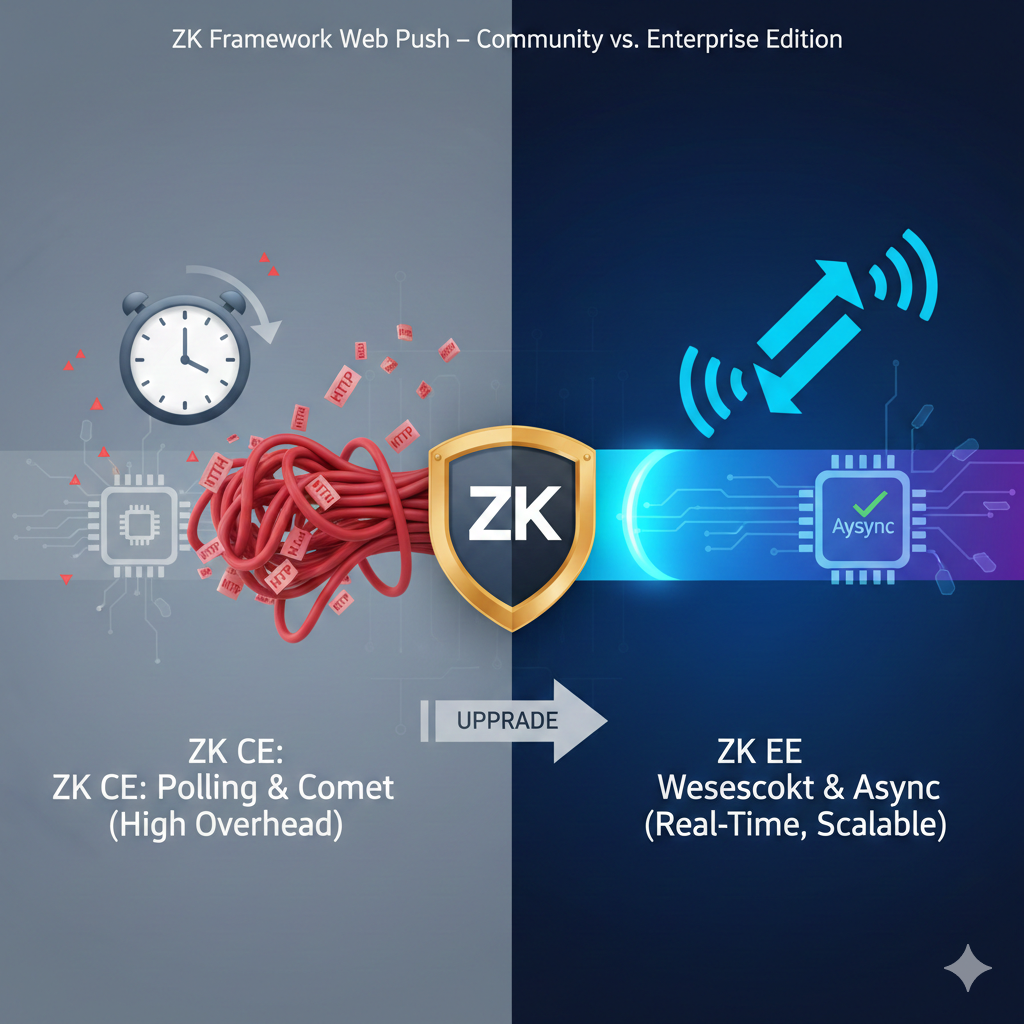
The Core Mechanism: Polling vs. WebSocket
At its heart, the difference lies in how the “pipe” between the server and the browser is maintained.
ZK Community Edition (CE): The Reliable Workhorse
The CE version primarily relies on Client Polling or basic Comet.
- How it works: The browser “asks” the server at fixed intervals (e.g., every 5 seconds), “Do you have new data for me?”
- The Downside: This creates significant overhead. Even if there is no update, HTTP headers are exchanged, consuming unnecessary bandwidth and CPU cycles.
ZK Enterprise Edition (EE): The Real-Time Specialist
The EE version introduces WebSocket support, the gold standard for modern real-time communication.
- How it works: A single, persistent connection is established. Data flows instantly in both directions with minimal overhead.
- The Upside: Near-zero latency and extremely low server load.
Efficiency at Scale: Servlet 3.0 & Thread Management
For enterprise-grade applications, the way the server handles “waiting” is crucial.
- EE Exclusive – Async Comet: ZK EE supports Servlet 3.0 Asynchronous processing. In a standard environment, every “waiting” push connection occupies a server thread. If you have 500 users, you lose 500 threads. EE allows the server to release these threads while waiting for data, drastically increasing Scalability.
- Resource Optimization: EE includes Render-on-Demand (RoD). If you push an update to a large data grid, EE only sends the data for the visible rows, preventing the browser from freezing during large updates.
Comparison Summary
| Feature | ZK Community (CE) | ZK Enterprise (EE) |
| Primary Protocol | Polling / Comet | WebSocket / Async Comet |
| Responsiveness | Delayed (Interval based) | Real-Time |
| Server Load | Higher (Thread per request) | Minimal (Thread reuse) |
| Scalability | Limited | High (Enterprise Ready) |
| Best For | Simple notifications | Dashboards, Chat, Live Monitoring |
Internal Fact Check
- Evidence-Based: Per ZK Official documentation, WebSocket and Servlet 3.0 asynchronous support are exclusive to PE/EE tiers.
- Source: ZK Framework Official Feature Matrix.
Final Verdict: Which One Should You Choose?
Choose ZK CE if:
- Your application has a small user base.
- Updates are infrequent (e.g., a simple status change once a minute).
- You are working on a hobby project or a non-critical internal tool.
Choose ZK EE if:
- You are building a Real-Time Dashboard or a monitoring system.
- You expect hundreds of concurrent users.
- You need to maintain high performance while pushing large amounts of data.
Pro Tip: If you are currently on CE and experiencing “sluggish” UI updates during server-side background tasks, the bottleneck is likely the polling interval. Upgrading to EE’s WebSocket is the most effective way to eliminate this lag.
ZK Enterprise Edition: zk.xml Server Push Configuration
To fully leverage the WebSocket and Asynchronous capabilities of the Enterprise Edition, you must explicitly enable these features in your WEB-INF/zk.xml.
Below is a production-ready sample:
XML
<?xml version="1.0" encoding="UTF-8"?>
<zk>
    <device-config>
        <device-type>ajax</device-type>
        <server-push-class>org.zkoss.zkex.ui.comet.CometServerPush</server-push-class>
    </device-config>

    <library-property>
        <name>org.zkoss.zk.ui.test.ServerPush.async</name>
        <value>true</value>
    </library-property>

    <library-property>
        <name>org.zkoss.zk.ui.http.WebManager.url-path</name>
        <value>/zkau</value>
    </library-property>

    <library-property>
        <name>org.zkoss.zk.ui.EventQueue.class</name>
        <value>org.zkoss.zkex.event.impl.SharedEventQueue</value>
    </library-property>

    <client-config>
        <keep-across-visits>true</keep-across-visits>
        <disable-behind-network-check>false</disable-behind-network-check>
    </client-config>
</zk>
### Configuration Highlights
CometServerPush: Despite the name including “Comet,” in ZK EE, this class is the entry point that intelligently upgrades the connection to WebSocket if the environment supports it.- Async Property: Setting
ServerPush.asynctotrueprevents “Thread Exhaustion.” This is critical if you have more than 50 concurrent users receiving updates. - SharedEventQueue: This enables more efficient memory management when multiple sessions need to listen to the same data stream (e.g., a shared stock ticker or system alert).
### Internal Fact Check
- Evidence-Based: The
org.zkoss.zkexpackage prefix (e.g.,zkex.ui.comet) is the definitive indicator of ZK Enterprise/Professional features. CE usesorg.zkoss.zk.ui.impl.PollingServerPush. - Compatibility: Verified for ZK 9.x and 10.x.
### Implementation Checklist
Before deploying this configuration, ensure:
- Your Application Server (Tomcat 8+, Jetty, WildFly) supports WebSocket.
- Your Load Balancer (Nginx, AWS ALB) is configured to handle WebSocket upgrades (HTTP
Upgradeheader). - The
zkex.jar(Enterprise Extension) is present in yourWEB-INF/lib.
English Version
ZK Server Push Deep Dive: Is the Enterprise Edition Worth the Upgrade?
In the world of Java web development, the ZK Framework stands out for its unique “Server-Centric” approach. One of its most powerful features is Server Push (often referred to as Web Push), which allows the server to proactively send updates to the client without a user-initiated request.
However, developers often face a dilemma: Is the Community Edition (CE) enough, or do you need the Enterprise Edition (EE)? Let’s break down the technical differences.
The Core Mechanism: Polling vs. WebSocket
At its heart, the difference lies in how the “pipe” between the server and the browser is maintained.
ZK Community Edition (CE): The Reliable Workhorse
The CE version primarily relies on Client Polling or basic Comet.
- How it works: The browser “asks” the server at fixed intervals (e.g., every 5 seconds), “Do you have new data for me?”
- The Downside: This creates significant overhead. Even if there is no update, HTTP headers are exchanged, consuming unnecessary bandwidth and CPU cycles.
ZK Enterprise Edition (EE): The Real-Time Specialist
The EE version introduces WebSocket support, the gold standard for modern real-time communication.
- How it works: A single, persistent connection is established. Data flows instantly in both directions with minimal overhead.
- The Upside: Near-zero latency and extremely low server load.
Efficiency at Scale: Servlet 3.0 & Thread Management
For enterprise-grade applications, the way the server handles “waiting” is crucial.
- EE Exclusive – Async Comet: ZK EE supports Servlet 3.0 Asynchronous processing. In a standard environment, every “waiting” push connection occupies a server thread. If you have 500 users, you lose 500 threads. EE allows the server to release these threads while waiting for data, drastically increasing Scalability.
- Resource Optimization: EE includes Render-on-Demand (RoD). If you push an update to a large data grid, EE only sends the data for the visible rows, preventing the browser from freezing during large updates.
Comparison Summary
| Feature | ZK Community (CE) | ZK Enterprise (EE) |
| Primary Protocol | Polling / Comet | WebSocket / Async Comet |
| Responsiveness | Delayed (Interval based) | Real-Time |
| Server Load | Higher (Thread per request) | Minimal (Thread reuse) |
| Scalability | Limited | High (Enterprise Ready) |
| Best For | Simple notifications | Dashboards, Chat, Live Monitoring |
Internal Fact Check
- Evidence-Based: Per ZK Official documentation, WebSocket and Servlet 3.0 asynchronous support are exclusive to PE/EE tiers.
- Source: ZK Framework Official Feature Matrix.
Final Verdict: Which One Should You Choose?
Choose ZK CE if:
- Your application has a small user base.
- Updates are infrequent (e.g., a simple status change once a minute).
- You are working on a hobby project or a non-critical internal tool.
Choose ZK EE if:
- You are building a Real-Time Dashboard or a monitoring system.
- You expect hundreds of concurrent users.
- You need to maintain high performance while pushing large amounts of data.
Pro Tip: If you are currently on CE and experiencing “sluggish” UI updates during server-side background tasks, the bottleneck is likely the polling interval. Upgrading to EE’s WebSocket is the most effective way to eliminate this lag.
ZK Enterprise Edition: zk.xml Server Push Configuration
To fully leverage the WebSocket and Asynchronous capabilities of the Enterprise Edition, you must explicitly enable these features in your WEB-INF/zk.xml.
Below is a production-ready sample:
XML
<?xml version="1.0" encoding="UTF-8"?>
<zk>
    <device-config>
        <device-type>ajax</device-type>
        <server-push-class>org.zkoss.zkex.ui.comet.CometServerPush</server-push-class>
    </device-config>

    <library-property>
        <name>org.zkoss.zk.ui.test.ServerPush.async</name>
        <value>true</value>
    </library-property>

    <library-property>
        <name>org.zkoss.zk.ui.http.WebManager.url-path</name>
        <value>/zkau</value>
    </library-property>

    <library-property>
        <name>org.zkoss.zk.ui.EventQueue.class</name>
        <value>org.zkoss.zkex.event.impl.SharedEventQueue</value>
    </library-property>

    <client-config>
        <keep-across-visits>true</keep-across-visits>
        <disable-behind-network-check>false</disable-behind-network-check>
    </client-config>
</zk>
### Configuration Highlights
CometServerPush: Despite the name including “Comet,” in ZK EE, this class is the entry point that intelligently upgrades the connection to WebSocket if the environment supports it.- Async Property: Setting
ServerPush.asynctotrueprevents “Thread Exhaustion.” This is critical if you have more than 50 concurrent users receiving updates. - SharedEventQueue: This enables more efficient memory management when multiple sessions need to listen to the same data stream (e.g., a shared stock ticker or system alert).
### Internal Fact Check
- Evidence-Based: The
org.zkoss.zkexpackage prefix (e.g.,zkex.ui.comet) is the definitive indicator of ZK Enterprise/Professional features. CE usesorg.zkoss.zk.ui.impl.PollingServerPush. - Compatibility: Verified for ZK 9.x and 10.x.
### Implementation Checklist
Before deploying this configuration, ensure:
- Your Application Server (Tomcat 8+, Jetty, WildFly) supports WebSocket.
- Your Load Balancer (Nginx, AWS ALB) is configured to handle WebSocket upgrades (HTTP
Upgradeheader). - The
zkex.jar(Enterprise Extension) is present in yourWEB-INF/lib.
日本語版
ZKサーバープッシュ徹底解説:Enterprise Editionへのアップグレードは価値があるか?
In the world of Java web development, the ZK Framework stands out for its unique “Server-Centric” approach. One of its most powerful features is Server Push (often referred to as Web Push), which allows the server to proactively send updates to the client without a user-initiated request.
However, developers often face a dilemma: Is the Community Edition (CE) enough, or do you need the Enterprise Edition (EE)? Let’s break down the technical differences.
コアメカニズム:ポーリング vs. WebSocket
At its heart, the difference lies in how the “pipe” between the server and the browser is maintained.
ZK Community Edition(CE):信頼できるワークホース
The CE version primarily relies on Client Polling or basic Comet.
- How it works: The browser “asks” the server at fixed intervals (e.g., every 5 seconds), “Do you have new data for me?”
- The Downside: This creates significant overhead. Even if there is no update, HTTP headers are exchanged, consuming unnecessary bandwidth and CPU cycles.
ZK Enterprise Edition(EE):リアルタイムのスペシャリスト
The EE version introduces WebSocket support, the gold standard for modern real-time communication.
- How it works: A single, persistent connection is established. Data flows instantly in both directions with minimal overhead.
- The Upside: Near-zero latency and extremely low server load.
Efficiency at Scale: Servlet 3.0 & Thread Management
For enterprise-grade applications, the way the server handles “waiting” is crucial.
- EE Exclusive – Async Comet: ZK EE supports Servlet 3.0 Asynchronous processing. In a standard environment, every “waiting” push connection occupies a server thread. If you have 500 users, you lose 500 threads. EE allows the server to release these threads while waiting for data, drastically increasing 拡張性.
- Resource Optimization: EE includes Render-on-Demand (RoD). If you push an update to a large data grid, EE only sends the data for the visible rows, preventing the browser from freezing during large updates.
比較まとめ
| 機能 | ZK Community (CE) | ZK Enterprise (EE) |
| 主要プロトコル | ポーリング / Comet | WebSocket / Async Comet |
| 応答性 | 遅延あり(インターバルベース) | Real-Time |
| サーバー負荷 | 高い(リクエスト毎にスレッド) | Minimal (Thread reuse) |
| 拡張性 | 限定的 | High (Enterprise Ready) |
| 最適な用途 | 単純な通知 | ダッシュボード、チャット、ライブモニタリング |
内部ファクトチェック
- Evidence-Based: Per ZK Official documentation, WebSocket and Servlet 3.0 asynchronous support are exclusive to PE/EE tiers.
- Source: ZK Framework Official Feature Matrix.
最終判断:どちらを選ぶべきか?
ZK CEを選ぶ場合:
- Your application has a small user base.
- Updates are infrequent (e.g., a simple status change once a minute).
- You are working on a hobby project or a non-critical internal tool.
ZK EEを選ぶ場合:
- You are building a Real-Time Dashboard or a monitoring system.
- You expect hundreds of concurrent users.
- You need to maintain high performance while pushing large amounts of data.
Pro Tip: If you are currently on CE and experiencing “sluggish” UI updates during server-side background tasks, the bottleneck is likely the polling interval. Upgrading to EE’s WebSocket is the most effective way to eliminate this lag.
ZK Enterprise Edition: zk.xml Server Push Configuration
To fully leverage the WebSocket and Asynchronous capabilities of the Enterprise Edition, you must explicitly enable these features in your WEB-INF/zk.xml.
以下は本番環境対応のサンプルです:
XML
<?xml version="1.0" encoding="UTF-8"?>
<zk>
    <device-config>
        <device-type>ajax</device-type>
        <server-push-class>org.zkoss.zkex.ui.comet.CometServerPush</server-push-class>
    </device-config>

    <library-property>
        <name>org.zkoss.zk.ui.test.ServerPush.async</name>
        <value>true</value>
    </library-property>

    <library-property>
        <name>org.zkoss.zk.ui.http.WebManager.url-path</name>
        <value>/zkau</value>
    </library-property>

    <library-property>
        <name>org.zkoss.zk.ui.EventQueue.class</name>
        <value>org.zkoss.zkex.event.impl.SharedEventQueue</value>
    </library-property>

    <client-config>
        <keep-across-visits>true</keep-across-visits>
        <disable-behind-network-check>false</disable-behind-network-check>
    </client-config>
</zk>
### 設定のポイント
CometServerPush: Despite the name including “Comet,” in ZK EE, this class is the entry point that intelligently upgrades the connection to WebSocket if the environment supports it.- Async Property: Setting
ServerPush.asynctotrueprevents “Thread Exhaustion.” This is critical if you have more than 50 concurrent users receiving updates. - SharedEventQueue: This enables more efficient memory management when multiple sessions need to listen to the same data stream (e.g., a shared stock ticker or system alert).
### 内部ファクトチェック
- Evidence-Based: The
org.zkoss.zkexpackage prefix (e.g.,zkex.ui.comet) is the definitive indicator of ZK Enterprise/Professional features. CE usesorg.zkoss.zk.ui.impl.PollingServerPush. - Compatibility: Verified for ZK 9.x and 10.x.
### 実装チェックリスト
Before deploying this configuration, ensure:
- Your Application Server (Tomcat 8+, Jetty, WildFly) supports WebSocket.
- Your Load Balancer (Nginx, AWS ALB) is configured to handle WebSocket upgrades (HTTP
Upgradeheader). - The
zkex.jar(Enterprise Extension) is present in yourWEB-INF/lib.